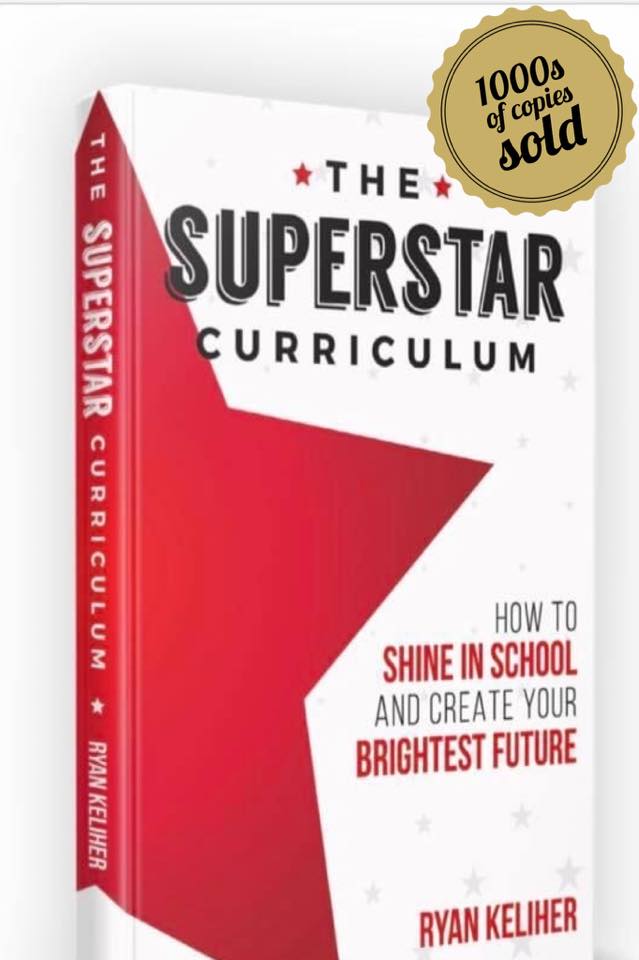
Packed with insightful stories and thought-provoking activities, The Superstar Curriculum is transforming the way teenagers approach school and life. Over 5,000 copies sold. Trusted by parents, teachers, and teens across North America. Still, most teens won’t read this book. But the ones who do? They’ll lead others.
Bulk orders and bulk pricing available for as low as $9.99/copy.
Most teens are taught to chase success.Few are taught how to build it from the inside out.
In a world obsessed with performance, pressure, and perfection, The Superstar Curriculum is a rare and timely guide for teens who want to do things right—even when no one else is.
This book isn’t about grades or trophies. It’s about character, consistency, and self-leadership.
Whether your teen is already driven or just starting to find their way, this book helps them:
✅ Build confidence that doesn’t depend on external praise ✅ Lead themselves when it’s easier to follow the crowd ✅ Develop habits that last long after high school ✅ Focus on what truly matters: integrity, growth, and contribution ✅ Navigate peer pressure and social noise with clarity and purpose
Written in a voice that respects teens without talking down to them, this is the mindset playbook for young people who want to grow when others coast.
Give your teen the edge that lasts a lifetime. Let them shine!
🎯 Buy now and help your teen start building their inner momentum today.
Hi, I’m Ryan Keliher
I’m a high school teacher and the author of The Superstar Curriculum. After working with teenagers for over a decade, I realized that the most important conversations I’ve ever had with students were about everyday success principles more than course content. I wrote this book to help empower teenagers to see school as an opportunity instead of an obligation.
The truth is, I believe you have star power. After reading this book, I think you will begin to see life and learning differently than before. You will see opportunities where others do not, and the positive results will follow. Are you ready to shine? It’s time to launch yourself into rare air.
Benefits of the Book
Since its release, The Superstar Curriculum has helped thousandsof teenagers unlock new and easy ways to strengthen relationships, improve self-confidence, lead by example, and inspire others. In this short book, I’ll explain how adopting a ‘Superstar Mindset’ will transform your approach to school and life. Here’s a powerful review I received from a 16-year-old reader:
“I’ve never liked books but this is a book everyone must read. It has helped me so much in school and mentally, I finally feel like I have a purpose and I look at everything so differently. I enjoy going to school its crazy because a week ago the only reason I was going to school was to leave my house and get nicotine, everyday of school was so boring and I was just trying to get through the day. I hated my life to be honest I wished I was never born. I had the worst year. Just last year I was skipping all my classes, of course I failed 3 of my classes, I thought my life was over and I wouldn’t make it anywhere in life.
Now I’m planning on staying in school and focusing in class, also helping everyone as much as possible. I want to pass all my classes and keep this amazing mindset. The chapters that stood out to me the most were “Don’t let your past define you” and “Being good to everyone” it seems simple but it makes so big of a difference, the feeling you get after helping someone is unexplainable the rush is amazing its the best high you can ask for and it’s a healthy one.
I have tried my best to help everyone around me and being the best I can be. I now realize I still have so much ahead of me and I’m extremely grateful to be alive right now. Even my mom has seen change so I told her about the book and she wanted to read it.”
I’m thrilled to report that this student earned all credits the following semester and has an improved outlook on life. This student was always a star – I’m happy the book helped in realizing it.
Written with Care
Layout and word choice are carefully crafted to respect teenagers as young adults
Conversational tone makes for light, easy reading
Short chapters (4 pages or less) are purposefully designed with reluctant readers in mind
Each chapter stands alone so readers can jump around as they wish
Self-assessment questions after each chapter help readers internalize concepts
Works as an independent read or full class/team activity
Valuable conversational resource to teachers, parents, or coaches
Every chapter will challenge your thinking in 10 minutes or less
A perfect gift for a teenager you believe in
Written by a veteran teenager at heart!
Other Superstar Testimonials
“It’s unlike any book I’ve ever read. It changed the way I view school.”
“It’s the only book I’ve read twice since I left high school. I live my life by it now.”
“It has done nothing but encourage me to become a better person each day.”
“If I had one wish, it would be that this book would have been available at the start of my high school journey.”
“After reading The Superstar Curriculum, I realized that education was one of the biggest investments I’ve made in my life.”
“It is a book I would recommend to anyone.”
“This book is a must for any teenager. Filled with amazing practical advice and written in a way that will captivate younger readers with that short teenage attention span.”
“Superstar Curriculum, although targeted to the teenage reader, serves as a beneficial read for educators.”
“The short chapters with relatable stories and tips to succeed make for an easy and enjoyable read.”
“This book provides the advice and knowledge we all wish we’d known as teenagers…and presents it in a non-preachy, non-parental way.”
Our students are stars – many just don’t know it yet. Together, we can create a school culture where more students live kindly, learn daily, and lead meaningfully in school and beyond.
By Ryan Keliher
The Potential Opportunity
Our schools are filled with potential. We know that.
Students, however, too often view school as an obligation instead of an opportunity, which limits their motivation to acquire knowledge or skills and to demonstrate their learning. What if, moving forward, we could intentionally create an environment where students are more self-motivated, self-aware, and self-confident learners?
In four steps, we can turn students into superstars!
The Process
Develop more leaders in every class.
Foster a ‘Superstar Mindset’ within students
Emphasize ‘CHOPS’ when setting direction
Implement more student-directed opportunities
1. Develop More Leaders in Every Class
Take leadership off its pedestal
Most people do not consider themselves leaders in the traditional sense. Because of the way society glorifies leadership, the notion of becoming a leader often becomes something that is destined for a select group of other people, not us.
Simplify Leadership
The following definitions simplify the notion that we are all leaders, that leadership is an act and not a title, and that effective leadership is never set in stone – it is transformational and situational. The choices we make matter and affect our environments. Self-awareness and reflection help us to evaluate the effectiveness of our leadership.
Leadership: Acting on the genuine belief that you can generate positive reactions for others and/or yourself.
Effective Leadership: The degree to which your actions generate positive reactions for others and/or yourself.
Discuss Leadership
Explicitly discussing acts of leadership and leadership opportunities with students can help them realize that their actions have the power to create positive reactions for themselves and others. They are leaders, both in their own lives and in the lives of others.
The more that students recognize and believe in their ability to create positive reactions, the more opportunities they will seize, and the more they will lead.
Celebrate Leadership
When we see actions create positive reactions, celebrate those efforts both individually and collectively.
2. Foster a ‘Superstar Mindset’ within Students
What is a Superstar Mindset?
A Superstar Mindset is a genuine desire to develop and contribute.
The concept of growth mindset is wildly popular in education. Growth mindset is a belief that one’s abilities and intelligence can be developed and improved over time through effort, perseverance, and learning. This concept, developed by psychologist Carol Dweck, contrasts with a fixed mindset, which is the belief that abilities are innate and cannot be changed. Individuals with a growth mindset are more likely to embrace challenges, persist in the face of setbacks, see effort as a path to mastery, and learn from criticism. By promoting a growth mindset, schools aim to help students see challenges as opportunities for growth, rather than obstacles to be avoided. This can lead to improved academic performance, as well as increased motivation and self-confidence.
A Superstar mindset builds upon Dr. Carol Dweck’s growth mindset theory by taking a further step to consider the contribution effect of a person’s beliefs and actions.
With a superstar mindset, there is not only a belief that purposeful actions can improve skills and knowledge over time, but also an extended belief that those actions can generate a positive impact on individuals, groups, situations, and environments. With a superstar mindset, students can develop not only skills, but high standards, positive relationships, self-awareness, opportunities, confidence, perspective, empathy, habits, gratitude, reputations, moments, and the list goes on.
Students with a superstar mindset become increasingly purposeful in how they approach school and increasingly prepared for life beyond school. Students embracing a superstar mindset will cultivate qualities that hold them in high demand and even higher regard. They will sharpen their skill sets and brighten each room they enter. They will create more moments in their lives where they live kindly, learn daily, and lead meaningfully. The more of these moments they create, the more fulfilled their lives become, both now and in the future.
3. Emphasize ‘CHOPS’ when Setting Direction with Students
What is CHOPS?
CHOPS is a performance planning and evaluative framework. Its name is an acronym that stands for Character, Habits, Opportunities, Priorities, and Skills. The framework is useful for daily or long-term planning and evaluation. It is useful for self-assessment or external assessment. Here is how it works:
Plan/Goal/Outcome:
Create and Deliver a Class Presentation
April 5, 2024
CHOPS Framework
Core Elements of High Performance
Notes/Eval:
Character
Calmness CourageResponsibility
Habits
Thinking and communicating with Clarity and precisionPersistingStriving for accuracy
Opportunities (for growth, contribution, and support)
Step out of my comfort zoneHelp others learn course contentSeek advice from teacher/peers
Priorities
Preparation (over procrastination) Visuals (over text when possible)Confidence (over memorization)
Skills
Communication skillsVisual-design skillsTime-management skills
The CHOPS framework acknowledges the importance of skill development while emphasizing other crucial elements of high performance and goal execution that are sometimes overlooked. These elements are major predictors of longstanding success. By prioritizing the aspects listed in the framework over skills, there’s a much better chance that the skills will improve as well.
4. Implement More Student-directed Learning Opportunities
What are examples?
Project-based Learning
Self-reflection
Group work
Co-constructed Success Criteria
Student choice
What about assessment?
Provide more advice than feedback
More formative than summative
Assess product, observations, and conversations
Include self-assessment
Focus more on distance covered than peak performance
What else works?
Connect the present to future
Embrace discomfort
Balance your communication
Include self-assessment
Frame challenges as opportunities
Anchor charts, word walls, quotes
The more we can get students to understand that the process of learning is as much about themselves as it is about the outcomes, the more we can engage them in learning. By focusing mainly on the outcome, like an exemplar, the process can become undervalued. When trying to reach the pinnacle, often times we need to rethink our process, back track, utilize supports, and re-strategize. Focusing on the personal character, habits, opportunities, and priorities required to demonstrate learning will help ensure the skills demonstrated are representative of our students’ best work.
As educators, we possess a transformative power—the ability to ignite the star power within our students. Just as stars illuminate the night sky, we have the extraordinary ability to inspire, influence, and shape the futures of those we teach.
Star Power in Students: Each student possesses a unique star power—an inherent brilliance that, when nurtured, can illuminate the world. Our role as teachers is to uncover and nurture this power, guiding students to discover their strengths, overcome challenges, and shine brightly in their own right.
Seeing Beyond the Clouds: Just as a star’s brilliance can be hidden behind clouds, our students’ potential may not always be immediately visible. As educators, it is our duty to look beyond the surface, or change our vantage points, to see the beauty and potential that lies within each and every student.
Creating a Ripple Effect: Just as a single star can light up the night sky, our actions as teachers can create a ripple effect, touching the lives of our students and beyond. Every lesson, every interaction, every moment of connection has the power to make a difference. Together, let us ignite their star power, empowering them to shine brightly and make a lasting impact on the world.
Conclusion: As we embrace our role as educators, let us remember that we are the guiding stars in our students’ lives. Together, let us ignite their star power, empowering them to shine brightly and make a lasting impact on the world.
The Parts of a Star
Core (Deep Belief): The core of the star is the central region that generates heat and energy. At the heart of the star analogy lies a person’s core belief: that your actions can create positive reactions for yourself and others. This belief serves as the foundation for personal growth and achievement. Encouraging your students to believe in their ability to make a difference, to strive for growth, and improve their personal circumstances.
Energy Zones (Focus Areas): Just as stars have different energy zones, students also need to focus their energy in key areas to achieve their full potential.
Character Development: Teach students the importance of integrity, responsibility, and moral strength in shaping their character. Help them develop strong values and a sense of purpose. Identify the character skills needed to achieve outcomes.
Habit Development: Guide students into demonstrating consistent positive behaviours. By developing positive habits like discipline, time management, and perseverance, student will be more ready and willing to seek and embrace challenges and discomfort.
Opportunity Development: Encourage students to seek out opportunities for learning, support, and contribution. Help them see every challenge as an opportunity to grow and shine.
Photosphere: The photosphere is the visible surface of a star, emitting light and heat. In personal development, the photosphere symbolizes the superstar mindset, which is a genuine desire to develop oneself and contribute to others. Just as the photosphere is easily detected by the naked eye, the superstar mindset makes individuals stand out as leaders and positive influences in their respective social circles.
Chromosphere and Corona (Impact on Others and Human Connection): The chromosphere and corona of a star extend for millions of miles, with strong magnetic fields. Likewise, your actions and energy have a powerful, far-reaching impact on others and the world. When you live kindly, learn daily, and contribute meaningfully, you create a magnetic field of positivity and connection, bringing people together and making the world a better place.
By adopting the star analogy and framework, you can inspire, influence, and shape the futures of your students, guiding them to shine brightly and make a positive impact on the world. Together, let us unleash our star power and illuminate the path to a brighter future for all.
Note: Skill development is not explicitly included in the Energy Zones section because education inherently focuses on skill development. This framework emphasizes the underlying principles that shape long-term performance, extending beyond skill development. By focusing on the three energy zones in this analogy, skill development will improve.
If you liked this post, please share it. Thanks for reading, and thanks for leading!
I remember reading about a college basketball scout who, whenever he heard of an incredible talent, would naturally go watch the kid play. The interesting part was that the scout would go to the game hoping that the kid would play poorly.
Seems counter-productive, right? The scout, however, was most interested in assessing elements of the athlete’s game that had little to do with technical skill, but so much to do with achieving consistent levels of high performance.
The scout wanted to know about the athlete’s habits when things were going south. He wanted to see the body language of an individual who was struggling to find success. He wanted to witness the true character of the person.
The scout already knew that if the player’s name made it across his desk, skill was no longer the most important part of the assessment. He actually wanted to know if the player had the chops to contribute on a daily basis, knowing that every day on the path to success is not a good day.
This story stuck with me as a reminder of what matters most when trying to sustain, and explain, consistent performance over the long-term. It made me think about my past experiences and also my future plans.
It led me to develop a framework, which I thought I’d share today in case someone might benefit from it.
It’s called the CHOPS Test.
CHOPS is an acronym that stands for Character, Habits, Opportunities, Priorities, and Skills.
The framework is a performance planning and evaluative tool that could be used by coaches, athletes, teachers, students, and organizations. The framework is useful for daily or long-term planning and evaluation. It works for individual self-assessment or external assessment.
And it’s easy to use.
Here’s what the simple template looks like:
The CHOPS Test
Event/Goal:
Character C
1. 2. 3.
Notes
Habits H
1. 2. 3.
Opportunities O
What opportunities can I seize? What opportunities can I create for others? What opportunities are there for support?
Priorities P
1. 2. 3.
Skills S
1. 2. 3.
What I like about this framework is that it still acknowledges the obvious importance of skill development, but it puts a heightened focus on other important core elements of high performance and goal execution that are sometimes overlooked even though they are major predictors of longstanding success. Plus, if you take care of what’s listed above skills in the framework, there’s a much better chance that the skills will take care of themselves.
Below are a couple examples of the template that I created for plans I have:
CHOPS Test Example #1
Goal: Run a personal best half-marathon time on October 15th, 2023 at the PEI Marathon
Character C
1. Self-Control (for training, food choices, and race pacing) 2. Patience (running is a sport of gradual, incremental, improvement) 3. Self-Awareness (follow a training plan and race plan but listen to my body)
Habits H
1. Persisting (months of training one day at a time. Setbacks are expected and accepted) 2. Managing impulsivity (resisting desire to stray from healthy food choices, to shorten workouts when my mind is telling me to quit, or to stay up late) 3. Taking responsible risks (wanting to challenge myself in a way that pushes my limits but doesn’t risk burnout or injury)
Opportunities O
1. What opportunities can I seize? Opportunity to live a healthier lifestyle and push myself outside my comfort zone. 2. What opportunities can I create for others? Opportunity for my two young kids to see me active and competing. 3. What opportunities are there for support? My running partners and Siobhan are always there for motivation and support.
Priorities P
1. Sleep (over screen time) 2. Stretching (over sitting on the couch) 3. Healthy food/hydration choices (over the alternative)
Skills S
1. Focus on form (toe strike, lean forward) 2. Strength training (3x workouts per week) 3. Hit weekly mileage targets and high intensity workout targets
CHOPS Test Example #2
Plan: Coach the Under 6 Stratford Foxes Basketball Program for the 2023-2024 season
Character C
1. Kindness 2. Patience 3. Fairness
Habits H
1. Communicating with clarity 2. Finding humour 3. Remaining open to continuous learning
Opportunities O
What opportunities can I seize? Opportunity to give back to a sport that provided me with a lot of joy. What opportunities can I create for others? Opportunity to help young people have fun and be active. What opportunities are there for support? Work collaboratively with other coaches and continue to search online for new ideas.
Priorities P
1. Fun (over competition) 2. Progress (over perfection) 3. Movement (over standing still)
This planning/evaluation framework can be used for any goal or event, such as:
Becoming a better teammate
Having a good week of practice/work
Preparing for an interview
Studying for upcoming exams
Being a more productive student
Learning a new skill
Preparing for a tough conversation at work
Here’s how the template works:
Identify the goal or plan
Choose your moral/mental qualities from the list (or add your own)
Character: Moral and Mental Qualities
Calmness
Courage
Compassion
Integrity
Kindness
Justice
Humility
Honesty
Respect
Loyalty
Forgiveness
Tolerance
Acceptance
Gratitude
Responsibility
Fairness
Patience
Self-Control
Self-Awareness
Love
3. Choose your Habits (I used the 16 Habits of Mind from Art Kosta and Bena Kallick, but you could use others too)
Habits: The 16 Habits of Mind
Persisting
Thinking and communicating with clarity and precision
Managing impulsivity
Gathering data through all senses
Listening with understanding and empathy
Creating, imagining, innovating
Thinking Flexibly
Responding with wonderment and awe
Thinking about thinking (metacognition)
Taking responsible risks
Striving for Accuracy
Finding Humor
Questioning and posing problems
Thinking interdependently
Applying past knowledge to new situations
Remaining open to continuous learning
4. Fill out the template
5. Review, assess, adjust as needed.
If you try giving the CHOPS Test a shot, I’d love to hear how it goes! If you found this article helpful, please share the post.
Thanks for reading, and thanks for leading!
Leadership: No Title Required
Many people have asked me, “What made you decide to write a book?” For years, I would give varying convoluted answers to what is a fairly straightforward question.
To be honest, sometimes I wasn’t sure why I felt I had the authority to release any book, let alone one that was titled, The Superstar Curriculum: How to Shine in School and Create Your Brightest Future.
To this day, it still seems like a bold endeavor on my part. I’m not an expert writer. I’m not an expert teacher. I’m not a leadership expert, and I’m still very much fumbling and struggling my way through my own life. Was it that I am a narcissist with some grandiose sense of self-importance? (It’s okay, I wondered about it too).
Finally, I’ve reached a point where I am able to explain why I wrote The Superstar Curriculum. Thankfully, where I landed has nothing to do with narcissism and everything to do with my ongoing understanding of leadership.
The Complexity of Leadership
When I was completing my MBA in 2013, I had a professor who quipped that there are as many definitions of leadership as there are people who have tried to define it. His comment always stuck with me as I dove deeper into the complex topic of effective leadership.
Well, it’s now time to add myself to the list.
If you google “Characteristics of an effective leader”, 24 qualities immediately pop up:
communication
accountability
creativity
self-awareness
delegation
learning
intelligence
empathy
emotional intelligence
decision-making
problem-solving
strategy
resilience
innovation
courage
decisiveness
integrity
confidence
humility
goals
active listening
transparency
positivity
honesty
(google.com)
Within the search result links that follow the above table, you’ll find that even more characteristics appear on more lists. For instance, when you visit the Harvard Business School Online, “ability to influence others” is added to the list. When you visit Forbes online, you’ll find “managing complexity” and “promoting teamwork” as top considerations. The Center for Creative Leadership has “gratitude” on its list. Visit more websites and find even more exceptional qualities.
All the traits listed above are tremendous; however, when looking at the list in its entirety, it’s daunting. Few people would read the list and say “yes, that pretty much sums me up!” So what can happen is that, instead, we make leadership out to be something that is bigger than ourselves. The notion of becoming a leader becomes something that is designated primarily for a select group of other people, not us.
Then we need to account for the varying leadership frameworks and styles. If you google “leadership styles”, there are 13 different leadership styles that immediately appear in the results:
Democratic
Transformational
Coaching
Transactional
Autocratic
Servant
Affiliative
Charismatic Authority
Strategic
Charismatic
Authoritarian
Bureaucratic
Direct
google.com
Within the subsequent google links, even more leadership styles like “laissez-faire”, “delegative”, and “visionary” emerge. Each style has its own unique elements, pros, and cons.
There are so many different leadership styles, frameworks, characteristics, and qualities that the concept of leadership can become more complex than it is accessible.
But what if there was a way to simplify leadership?
Simplifying Leadership
We can’t demonstrate all of those effective leadership qualities at once, but we can demonstrate any one of them at any time. As a result, here are my simplified definitions of leadership and effective leadership.
Leadership: Acting on the genuine belief that you can generate positive reactions for others and/or yourself.
Effective Leadership: The degree to which your actions generate positive reactions for others and/or yourself.
Let’s unpack this definition.
Effective leadership is not a style. It’s not a designation. It’s not a set group of characteristics.
Sometimes it’s communication. Sometimes it’s courage.
Sometimes it’s persistence. Sometimes it’s patience.
Sometimes it’s laissez-faire. Sometimes it’s authoritarian. Sometimes it’s democratic.
Sometimes it comes from the president of the company. Sometimes it comes from a stranger on the street. Sometimes it’s a monumental initiative. Sometimes it’s a small act of kindness.
Leadership is any action based on a genuine belief that you have the ability and opportunity to positively affect and influence those around you (yourself included – the best leader in your own life should also be you).
I wrote The Superstar Curriculum because I genuinely believed that the act of doing so could create a positive reaction in the lives of others. And consequently, that’s what the entire book is about – the genuine desire to develop and contribute, which is The Superstar Mindset. The alternative to writing the book was to not write the book, and my genuine belief reached a point where that was no longer an option. Releasing the book was no longer a risk to take but an opportunity to seize.
The more I believe in my ability to create positive reactions, the more opportunities I will seize. The more I will lead.
As I mentioned earlier, I’m not a psychologist. I’m not a professor. I’m not a leadership expert. I still continue to fail at things I’m trying to accomplish. I’m sure some people don’t even like my book, and I know I’ll miss future opportunities to lead.
But I still genuinely believe that my next move can be one of positivity. I do still consider myself a leader.
And here’s the thing: I consider you a leader, too, whether you believe it or not! I have no question that your actions can create positive reactions in the lives of others. For any moment of leadership, there is no title required – only a genuine belief in your ability to act positively in a given moment.



 It's Your Time to Shine